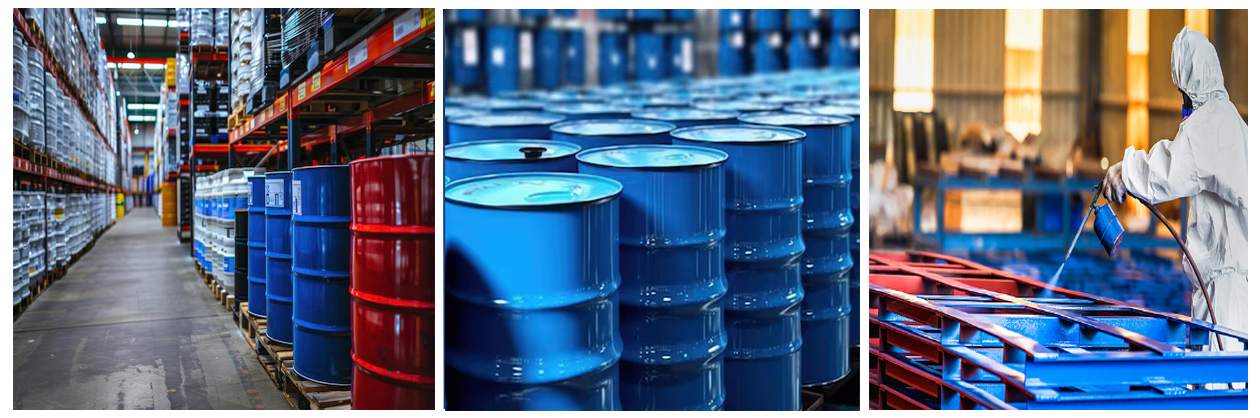
Zinc-rich epoxy powder coating provides excellent corrosion resistance for steel substrates through the cathodic protection effect of zinc powder. It is especially suitable for heavy-duty anti-corrosion fields such as bridges, pipelines, storage tanks, and steel structures.
This article systematically introduces the concept, features, functions, anti-corrosion principles, application fields, selection considerations, and common problem-solving measures of zinc-rich epoxy powder coating. It focuses on the functions of zinc-rich epoxy powder coating to help everyone better understand what zinc-rich epoxy powder coating is, its characteristics, and application fields.

What Is Zinc-Rich Epoxy Powder Coating
Zinc-rich epoxy powder coating is a thermosetting powder coating that uses epoxy resin as the film-forming base material and high-content zinc powder (usually accounting for more than 77% of the dry film weight) as the main anti-rust pigment.
Features of Zinc-Rich Epoxy Powder Coating
The main features of zinc-rich epoxy powder coating are as follows.
- Excellent Cathodic Protection Anti-Corrosion Performance
This is its core value. The coating contains a large amount of zinc powder (usually accounting for more than 77% of the dry film weight). Zinc has a more negative potential than steel and acts as a “sacrificial anode” in corrosive environments, being preferentially corroded to protect the steel substrate. Even if the coating is locally damaged, the exposed steel can still receive protection. It is especially suitable for heavy-duty anti-corrosion applications such as marine facilities, bridges, and pipelines.
- High Zinc Content and Electrical Connectivity Requirements
Effective cathodic protection requires sufficiently high zinc powder content to ensure good electrical contact between zinc particles and between zinc particles and the substrate. High zinc content also results in a lower resin proportion, which may cause coating porosity. Therefore, it is usually necessary to use it together with a topcoat.
- Excellent Physical and Mechanical Properties
Epoxy resin provides the coating with excellent adhesion (especially on sandblasted steel), high hardness (≥2H), good flexibility (capable of passing a 1mm bending test), and strong impact resistance, providing excellent physical protection.
- Strict Matching System Requirements
Because epoxy resin has poor weather resistance and zinc-rich coatings have pores, zinc-rich epoxy coatings are usually used as primers. They must be combined with weather-resistant intermediate coatings or topcoats (such as polyester and polyurethane powder coatings) to form a “primer anti-corrosion + topcoat protection” composite system, achieving long-term outdoor durability.
- Environmental Advantages and High Construction Requirements
It has the environmental advantages common to powder coatings, such as nearly zero VOC and recyclable overspray powder. However, substrate treatment requirements are extremely strict during application. Generally, thorough sandblasting cleaning (above Sa2.5 grade) is required to ensure adhesion and anti-corrosion performance. During storage, moisture and heat must be avoided to prevent zinc powder oxidation or agglomeration.
Functions of Zinc-Rich Epoxy Powder Coating
The main functions of zinc-rich epoxy powder coating are reflected in the following aspects.
- Long-Term Cathodic Anti-Corrosion Function
The high-content zinc powder in the coating (≥77%) acts as a sacrificial anode and corrodes preferentially, protecting the steel substrate from rust. Even if the coating is locally damaged, exposed steel can still receive protection. The anti-corrosion service life is significantly extended, making it especially suitable for highly corrosive environments such as marine, chemical, and bridge applications.
- Physical Barrier and Mechanical Protection Function
The dense coating formed by epoxy resin provides high adhesion (on sandblasted steel), high hardness (≥2H), and good flexibility. It can effectively block the penetration of moisture, oxygen, and corrosive media while resisting mechanical impact and wear.
- Primer Function in Coating Systems
Epoxy resin has poor weather resistance, and high zinc-content coatings contain pores. Therefore, zinc-rich epoxy coatings are usually used as primers and need to be combined with weather-resistant topcoats (polyester, polyurethane, etc.) to form a composite coating system. The primer provides cathodic corrosion protection, while the topcoat provides UV resistance and decoration.
Anti-Corrosion Principles of Zinc-Rich Epoxy Powder Coating
The anti-corrosion principle of zinc-rich epoxy powder coating is based on a dual protection mechanism: electrochemical cathodic protection as the primary method and physical barrier protection as a secondary method.
- Cathodic Protection
The high-content zinc powder in the coating (usually accounting for more than 77% of the dry film weight) is in close contact with the steel substrate. When corrosive media (moisture and oxygen) penetrate the coating, zinc and iron form a corrosion microcell. The potential of zinc (-0.76V) is more negative than that of iron (-0.44V), so zinc powder acts as a sacrificial anode and loses electrons first through corrosion:
Zn → Zn²⁺ + 2e⁻
The steel substrate acts as the cathode and is protected:
O₂ + 2H₂O + 4e⁻ → 4OH⁻
This effectively inhibits substrate corrosion. Even if the coating is locally damaged, exposed steel can still obtain cathodic protection.
- Physical Barrier Protection
Corrosion products such as basic zinc carbonate generated during zinc corrosion deposit in coating pores, blocking corrosion medium penetration channels and slowing down the rate at which moisture and oxygen reach the substrate surface, further enhancing protection performance.
Application Fields of Zinc-Rich Epoxy Powder Coating
Zinc-rich epoxy powder coating is mainly applied in heavy-duty anti-corrosion fields.
- Bridge and Steel Structure Fields
It is applied to steel box girders, cables, bridge pier steel structures of highway bridges, railway bridges, and sea-crossing bridges, as well as large-scale building steel structures (stadiums, exhibition centers, and high-rise building steel frames). Zinc-rich epoxy primer provides long-term cathodic protection and works together with weather-resistant topcoats to form composite coating systems, ensuring corrosion resistance of bridges and steel structures during long-term outdoor exposure and extending maintenance intervals.
- Petroleum and Chemical Facility Fields
It is applied to crude oil storage tanks, internal and external surfaces of chemical storage tanks, oil and gas pipelines, refining equipment, reactors, towers, and other facilities. These facilities are exposed to corrosive media or high humidity and acidic/alkaline environments for long periods. Zinc-rich epoxy primer can effectively inhibit substrate corrosion, ensure safe operation, and reduce maintenance frequency.
- Marine Engineering and Ship Fields
It is applied to offshore platform legs, jacket structures, port machinery, ship hulls, ballast tanks, containers, and other equipment. Marine environments have high salt spray, high humidity, and strong UV exposure, resulting in severe corrosion. As the primer layer in heavy-duty anti-corrosion systems, zinc-rich epoxy provides long-lasting cathodic protection and serves as a basic protection solution for marine corrosion prevention.
- Power and Communication Facility Fields
It is applied to transmission towers, wind turbine towers, communication base station towers, substation steel structures, and other facilities. These structures are exposed outdoors for long periods and are difficult to maintain. Zinc-rich epoxy primer combined with weather-resistant topcoats can provide more than 20 years of long-term corrosion protection, reducing the risks of high-altitude maintenance operations.
- Industrial Equipment and Infrastructure Fields
It is applied to rail transit vehicle frames, mining machinery, agricultural machinery, water treatment equipment, municipal guardrails, railway switches, and other equipment. These facilities are often exposed to humid, abrasive, or mildly corrosive environments. Zinc-rich epoxy primer provides basic corrosion protection and extends equipment service life.
- Construction Machinery and Automotive Chassis Component Fields
It is applied to structural components of excavators, cranes, and other construction machinery, as well as automotive frames and chassis suspension components. These parts face both mechanical impact and corrosion challenges. Zinc-rich epoxy primer provides highly adhesive and impact-resistant anti-corrosion coatings, protecting substrates from stone impact and corrosion damage.
How to Select Zinc-Rich Epoxy Powder Coating
When selecting zinc-rich epoxy powder coating, many users may not know how to choose. Based on our industry experience, we recommend paying attention to the following aspects.
- Check Zinc Powder Content: The Core Factor Determining Anti-Corrosion Performance
Zinc powder content is the primary indicator for measuring corrosion protection capability.
(1) National standard requirements: According to HG/T 3668. the metallic zinc content in the non-volatile portion of zinc-rich epoxy primer is generally required to be no less than 70%.
(2) Optimal range: 70%-85% is recognized as the “golden range,” balancing cathodic protection performance and coating adhesion. Too low content (such as 30%-50% non-standard products) provides limited protection; above 85%, the coating may become brittle and adhesion may decrease.
(3) International reference: SSPC Paint 20 specifies that the zinc powder content in dry film of organic zinc-rich coatings should be no less than 77%.
- Consider Application Environment and Supporting System
Because epoxy resin itself has poor UV resistance and zinc-rich coatings contain pores, zinc-rich epoxy coatings are usually used as primers and must be combined with intermediate and topcoats to achieve long-term outdoor protection.
(1) Heavy-duty corrosion environments (bridges, offshore platforms, storage tanks): Products with high zinc content (such as ≥80%) should be selected, combined with epoxy micaceous iron intermediate coating + weather-resistant polyurethane/fluorocarbon topcoat.
(2) General steel structures: Qualified products can be selected according to standards and matched with appropriate anti-rust intermediate coatings and topcoats.
- Consider Construction Conditions and Substrate Treatment
Good adhesion is the prerequisite for achieving cathodic protection.
(1) Substrate treatment: Thorough sandblasting cleaning must be performed to reach Sa2.5 grade, meaning the substrate surface should show metallic appearance without rust or oil contamination.
(2) Construction environment: Generally, the ambient temperature should be above 5℃, and the substrate surface temperature should be more than 3℃ above the dew point.
Common Problems and Solutions of Zinc-Rich Epoxy Powder Coating
The most common problems during the use of zinc-rich epoxy powder coating are mainly reflected in the following aspects. Based on our industry experience, we provide corresponding solutions to help effectively solve powder coating problems.
- Poor Adhesion or Coating Peeling
Problem Description:
Poor bonding between the coating and substrate, peeling or falling off during impact or bending.
Main Causes:
Incomplete substrate surface treatment (remaining rust, oil contamination, or oxide scale); insufficient sandblasting roughness or residual dust; insufficient curing resulting in low crosslinking density; excessive coating thickness (>100μm) causing increased internal stress.
Solutions:
Thoroughly sandblast to Sa2.5 grade, achieve surface roughness Rz of 40~100μm, and remove surface dust; strictly control curing temperature and time to ensure sufficient crosslinking; control film thickness at 60~80μm to avoid excessive one-time spraying thickness.
- Crater or Pinhole Problems
Problem Description:
Volcano-like depressions or small open holes appear on the coating surface.
Main Causes:
Incomplete removal of oil or moisture from the substrate; oil and water in compressed air; excessive coating thickness preventing internal gas release; powder moisture absorption; uneven zinc powder dispersion or moisture oxidation.
Solutions:
Strengthen degreasing and drying during pretreatment; install precision oil-water separators to ensure compressed air oil content ≤0.1mg/m³ and dew point ≤-20℃; control film thickness at 60~80μm; store powder below 25℃ with RH<60%; select well-dispersed zinc powder to ensure uniform mixing of zinc powder and resin.
- Rough Surface or Orange Peel Problems
Problem Description:
The coating surface is uneven, showing orange peel texture or obvious particle feeling.
Main Causes:
Zinc powder particle size is too large or particle distribution is uneven; insufficient film thickness (<50μm); rapid heating during curing causes insufficient leveling; excessive spraying voltage causes zinc powder breakdown and accumulation.
Solutions:
Select zinc powder with suitable particle size distribution and control powder fineness; control film thickness at 60~80μm; adopt staged heating curves to provide sufficient leveling time; adjust electrostatic voltage to 60~80kV with gun distance of 200~300mm.
- Insufficient Anti-Corrosion Performance
Problem Description:
Red rust or corrosion expansion appears during salt spray testing.
Main Causes:
Insufficient zinc powder content (<70%), resulting in inadequate cathodic protection; pinholes or excessive porosity allowing corrosion media penetration; uneven film thickness with locally thin areas; insufficient curing causing low crosslinking density and poor barrier performance.
Solutions:
Confirm zinc powder content meets requirements (according to HG/T 3668. metallic zinc content in non-volatile portion ≥70%); control uniform film thickness (60~80μm) and avoid locally thin coating; strictly control curing process to ensure sufficient crosslinking; for high anti-corrosion requirements, use intermediate and topcoats to form a complete coating system.
- Storage Agglomeration or Thickening Problems
Problem Description:
Powder forms lumps during storage or shows poor fluidization during spraying.
Main Causes:
Zinc powder absorbs moisture and oxidizes to generate gas; storage temperature is too high or humidity is excessive; pre-reaction between epoxy resin and curing agent.
Solutions:
Store powder in a dry, light-protected environment below 25℃ and RH<60%, away from heat sources; sieve before use; ensure packaging is well sealed to prevent moisture absorption.
- Low Powder Deposition Efficiency or Electrostatic Shielding Problems
Problem Description:
Powder deposition is difficult in recessed areas of complex workpieces, or overall powder application efficiency is low.
Main Causes:
High conductivity of zinc powder easily causes electrostatic shielding; spraying distance is too close or voltage is too high; poor powder charging performance.
Solutions:
Adjust spraying voltage to 60~80kV, increase gun distance to 250~300mm, and reduce electrostatic shielding effects; use multi-angle spraying or manual touch-up spraying for complex workpieces; select suitable additives to improve powder charging performance.
If you encounter difficult problems during the use of zinc-rich epoxy powder coating, please feel free to contact us at any time to obtain professional technical support, discuss solutions together, and promote the development of the powder coating industry.
We hope this article provides you with a professional and reliable reference related to the powder coating industry. We sincerely welcome you to consult us regarding product performance, industry standards, application methods, precautions, or any other related questions about powder coating products. Please feel free to leave a message or contact us directly so that we can provide more detailed product information, demonstration videos, or customized solutions to help you fully understand the functions and advantages of our products.